

A shop alignment uses a computerized machine, but two of the three main alignment angles, toe and camber, can be checked at home with simple tools. That is useful after replacing a tie rod, before a long trip, or to see whether uneven tire wear is an alignment problem.
This guide explains what each tool measures, how to use it, its limits, and two tools to consider.
What you’ll learn
- The three alignment angles
- Which tools measure which angle
- How to check toe and camber at home
- When you still need a shop
Quick answer
For home checks, the most useful tools are toe plates (or a string line) for measuring toe, and a magnetic camber gauge for camber. Both need a level floor and the car settled at normal ride height. Home tools are good for checking and rough adjustment after a repair, but a shop alignment is still needed for a full four-wheel alignment, caster changes, and cars with driver-assist cameras that need recalibration.
In this article

The three alignment angles
- Toe is whether the fronts of the tires point slightly in or out when viewed from above. Wrong toe is the most common cause of fast, feathered tire wear.
- Camber is the tilt of the tire when viewed from the front. Too much tilt wears one edge of the tire.
- Caster is the angle of the steering axis viewed from the side. It affects straight-line stability and steering return; it is harder to measure and often not adjustable without parts.
Signs that the alignment is off include the car pulling to one side, an off-center steering wheel and uneven tire wear. See wheel alignment problem symptoms.
Types of home alignment tools
- Toe plates: flat plates that rest against each front tire, with tape measures between them. The difference between the front and rear measurements is the toe.
- String line: two strings run along the sides of the car on stands. It costs almost nothing and also shows rear toe, but takes longer to set up.
- Magnetic camber gauge: a bubble or digital gauge that sticks to the hub or a flat adapter and reads camber in degrees. Some also read caster with a turn-plate procedure.
- Turn plates: let the tires turn freely, needed for accurate caster readings.
How to choose
- Start with toe. It matters most for tire wear, so toe plates or a string line are the first tool to get.
- Readability. Clear scales and magnets that hold firmly make readings repeatable.
- Fit. Check that the camber gauge fits your hub or wheel; some need an adapter.
- Accuracy expectations. Home tools are fine for checking and rough setting. For fine settings, a shop machine is more precise.

How to check toe and camber at home
- Park on a level floor, with normal tire pressures and the steering wheel straight.
- Roll the car forward and back a little so the suspension settles; do not take readings with the car on jacks.
- Toe: place the plates against the tire sidewalls, read the front and rear tape measurements, and subtract. Compare with the specification for your car.
- Camber: hold or attach the gauge to the hub or a flat wheel surface, zero it on the level floor if it has that function, and read the angle on each side.
- Write the readings down, make any adjustment, then roll the car and measure again.
- If the numbers are far off, or a part looks bent or worn, have the suspension checked.
When you still need a shop
- Cars with lane-keeping or other driver-assist cameras may need a calibration after an alignment.
- Rear-wheel alignment and thrust angle are hard to set accurately at home.
- Caster and camber on many cars need special bolts or parts to adjust.
- Worn tie rods, ball joints or bushings must be replaced before any alignment is accurate.
See also wheel balancing and how it differs from alignment.
Alignment tools to consider
How we chose: We have not tested these tools ourselves. We looked for toe and camber tools that home mechanics commonly use, based on what each maker lists, and we checked each Amazon listing on November 17, 2026: in stock, rated 4.3 stars or higher, with at least 500 ratings. No string alignment kit met that bar, so none is listed.
1. Longacre 79501 Aluminum Toe Plates with Tape Measures

A pair of aluminum toe plates with magnets and two tape measures, from a maker of motorsport setup tools. Used to compare the front and rear distances between the tires.
Why it’s a good pick
- Simple and reusable
- Includes both tape measures
- Established setup-tool brand
Keep in mind
- Needs a level floor
- Measures toe only
2. Ziopetru Magnetic Camber Gauge
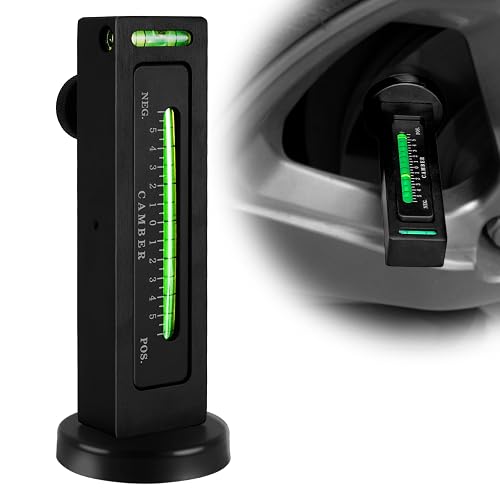
A low-cost magnetic camber gauge for reading wheel tilt in degrees. It is from a lesser-known brand, so check it on the level floor first.
Why it’s a good pick
- Low cost
- Magnetic mount
- Met our rating bar
Keep in mind
- Lesser-known brand
- May need a flat surface or adapter on some hubs